Posts

Congrats to Yuchen Wei on His Graduation!

Image
  Yuchen Wei joined the NLP group in the fall of 2024, the second year of his masters program, to work on use of LLMs for assessment of student's conceptual understanding of statistics based on their responses to short answer questions. He graduated, then commenced on May 11, 2025, as shown here with his advisor Becky Passonneau.

2025 Spring NLP Lab Party!

Image
On May 10th, marking the end of the 2025 Spring semester, the annual NLP gathering was hosted at the home of Prof. Rebecca J. Passonneau. The event brought together members from three NLP research groups in the Penn State Computer Science and Engineering department, led by Prof. Rebecca J. Passonneau, Prof. Rui Zhang, and Prof. Wenpeng Yin. Everyone was happy that we had a day of warm sunshine, since it had been raining all week. It was the first time the NLP party used the firepit, which lent a special spark. 😉

Celebrating Connections: Prof. Rebecca Passonneau and Prof. Yanjun Gao at COLM 2024

Image
  From October 7-9, 2024, Prof. Rebecca Passonneau and her former PhD student, Prof. Yanjun Gao, attended COLM 2024 in Philadelphia. Prof. Gao is now an Assistant Professor at the University of Colorado Anschutz Medical Campus, where she is making significant contributions in AI and biomedical informatics. It was wonderful to celebrate her achievements and reconnect!

Cheers to Mahsa Sheikhi: A Graduation Celebration

Image
  Congratulations to Mahsa on her well-deserved Master’s graduation! 🎉 We had a wonderful time celebrating this milestone at Professor Rebecca Passonneau’s home, surrounded by friends and great conversations. Wishing Mahsa all the best in her future endeavors—this is just the beginning of many more successes to come! 🌟 

Fall 2024 NLP lab party!

Image
On September 20th, the annual NLP party was hosted at the home of Prof Rebecca J. Passonneau, bringing together members from three NLP research groups in the Penn State Computer Science and Engineering department. The three groups, led by Prof Rebecca J. Passonneau, Prof Rui Zhang and Prof Wenpeng Yin. The event was a delightful blend of intellectual conversations and casual socializing. In attendance were the three professors, their students, and a few invited friends. The gathering provided an opportunity for researchers across the groups to discuss their ongoing projects, exchange ideas, and strengthen the collaborative spirit that defines Penn State’s NLP community. Photo Caption: From left to right Third Row: Renze Lou, Nan Zhang, Hongchao Fang, Tingyang Sun Second Row: Ryo Kamoi, Sarkar Snigdha Sarathi Das, Wenpeng Yin, Vipul Gupta, Berk Atil, Yuchen Wei First Row: Rui Zhang, Ibraheem Moosa, Zhuoyang Zou, Rebecca J. Passonneau, Janice Ahn, Ranran Haoran Zhang, Ruihao Pan

Vipul' Comprehensive Exam

Image
  Congratulations, Vipul, on passing his comprehensive exam, and  delivering an impressive  presentation  on "Responsible AI: Towards Equitable Model Evaluation" ! Here’s to his continued success and the amazing accomplishments that surely lie ahead in his PhD journey!

Zhaohui Li's Graduation Party

Image
  ChatGPT Congratulations to Zhaohui Li on the remarkable achievement of graduating with a doctorate and successfully defending the dissertation! To celebrate this momentous occasion, family and colleagues gathered to honor Zhaohui's accomplishments and to toast to the bright future that lies ahead. We are all incredibly proud of Zhaohui and look forward to seeing the continued success and contributions to the field. Well done, Dr. Li!

Fall 2023 NLP lab party!

Image
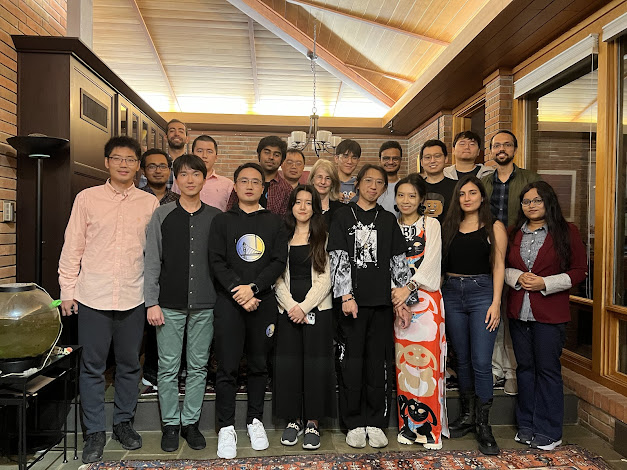
  The NLP lab team recently gathered at Becky's house for a casual get-together. It was a great mix of familiar faces and some fresh additions to the group. We had a good time chatting, exchanging NLP insights, and breaking the ice with our new lab colleagues. Becky's place offered an ideal setting for a laid-back evening, and it provided an excellent opportunity to socialize outside of our typical lab environment. Here's to more such gatherings in the future! 🎉🤝🏠

Artificial Intelligence in Science Education Workshop

Image
The "AI in Science Education" workshop hosted by this team of six aimed to introduce four teachers from Pennsylvania to the exciting world of artificial intelligence (AI) in education. Through engaging sessions, hands-on activities, and real-world examples, the teachers gained a deeper understanding of AI's potential to enhance student learning experiences.   During the 2023/23 academic year, the four teachers will be using science essay prompts in their instruction that we created during the workshop. They will send us their students’ essays that we will evaluate with our PyrEval content assessment software. We will meet with them again in the summer of 2024 for a follow-up workshop.

First NLP Lab Party of 2023

Image
  First NLP lab party of 2023! An outdoor event in which some of the older lab members get to hang out with the new members, discuss and share their ideas. And also, eat some delicious snacks!

Maryam Zare EMNLP Paper

Image
Maryam Zare (NLP Ph.D. Penn State) has a 2022 EMNLP paper based on her thesis: "A POMDP Dialogue Policy with 3-way Grounding and Adaptive Sensing for Learning through Communication " .  Maryam, who has been at Apple since her graduation in August 2021, developed a single dialogue policy for an artificial agent to learn board games from people through multimodal dialogue interaction. It adapts its questions to its evolving perception of how informative the current dialogue partner is, and it can continue learning across dialogues.

An NLP Lab Project is Featured in PSU Engineering News

Image
The NLP Lab's recent contributions to a collaboration with University of  Wisconsin's Center for Education Research  are featured in an October 2022 article in the PSU Engineering News.  The article describes two recent publications leading to deployment of our content assessment software,  PyrEval , in middle school classrooms in Wisconsin for assessment of students' understanding of physics ideas.

Hiking the Allegheny Front Trail

Image
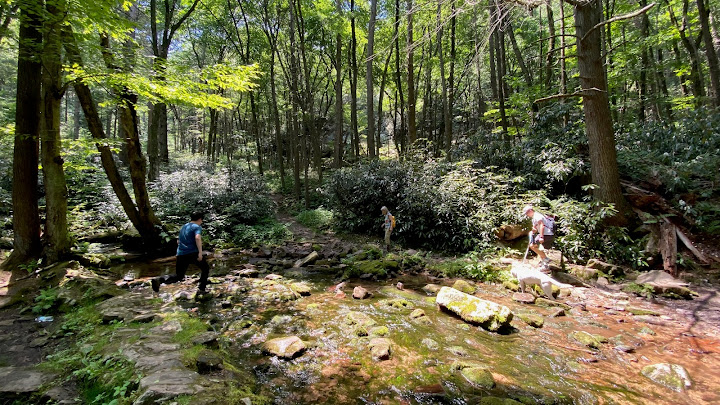
    Becky, Ruihao, Zhaohui, Berk and lovely Renno are enjoying the great view and nice weather On 10/09, we hiked for the first time this Fall to enjoy the weather and nice views. We hiked from Beaver Mills to Ralph's Majestic Vista of Allegheny Front Trail. It was a great social event as you can see from the pictures. Pretty good at Ralph's Majestic Vista

Lab Party Fall 22

Image
  Another NLP lab party! As a tradition, every year Dr. Passonneau invites all the NLP lab members to her house for students to get to know each other better as the school year begins. This year, the NLP lab party was an outdoor event with some grilled food!

Shingleton Gap Hike

Image
  Our lab went to Shingleton Gap hiking trail which is just 10 minutes away. It was an adventurous and a fun trail. We got lost 2 times with no internet but thanks to Ruihao’s navigation skills using AllTrails app which ensured we were not lost for long. Chase, Zhaohui’s dog, ensured that we never took a long stop and completed our hike earlier than expected! Hiking is always fun!

Contrastive Data and Learning for Natural Language Processing, Tutorial at NAACL 2022

Image
  Current NLP models heavily rely on effective representation learning algorithms. Contrastive learning is one such technique to learn an embedding space such that similar data sample pairs have close representations while dissimilar samples stay far apart from each other. It can be used in supervised or unsupervised settings using different loss functions to produce task-specific or general-purpose representations. While it has originally enabled the success for vision tasks, recent years have seen a growing number of publications in contrastive NLP. This first line of works not only delivers promising performance improvements in various NLP tasks, but also provides desired characteristics such as task-agnostic sentence representation, faithful text generation, data-efficient learning in zero-shot and few-shot settings, interpretability and explainability.

The first NLP Lab Hiking Event in 2022

Image
  The NLP Lab had its first hiking event of the year 2022 on June 9, 2022 at the 1000 Steps Trail in Huntingdon County. The hike covers approximately 850 feet of elevation change over the course of 0.5 miles. Dr. Passonneau found this really beautiful and challenging hike and all the lab members enjoyed the incredible views from the top of the steps.

Lab Party Fall 21

Image
As is the tradition, Dr. Passonneau hosted the first NLP lab party in her backyard last Friday (10th September). All of the lab members and associates alongside the new faculty Dr. Zhang enjoyed a break from the weekly work and meet with out honorary lab member Renno!

First in person meeting of the Academic Year

Image
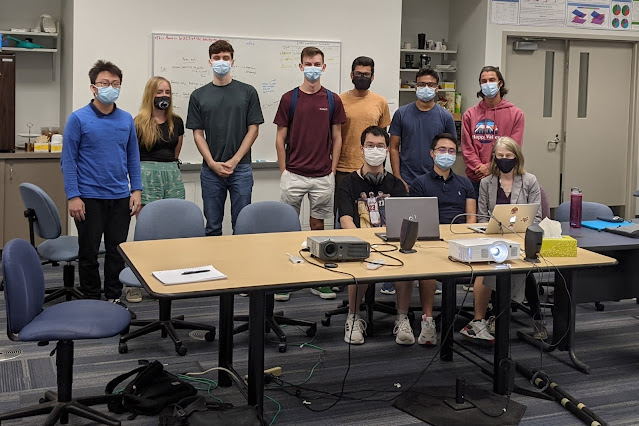
  The NLP Lab had its first in person meeting of the semester on September 2, 2021 in the lab space at Westgate Building. The main presenter for the meeting was Zhaohui who talked about his work which recently got accepted at EMNLP 2021. More information about the paper can be found in the blog post here . We also had the pleasure of having a few guests from the Center for Language Science who will be collaborating with us over the course of the semester! 

Paper Accepted in the EMNLP 21 Main Conference: A Semantic Feature-Wise Transformation Relation Network for Automatic Short Answer Grading

Image
  Congratulations! A paper by Zhaohui Li, Yajur Tomar, and Rebecca J. Passonneau,  "A Semantic Feature-Wise Transformation Relation Network for Automatic Short Answer Grading", has been accepted to the 2021 Conference on Empirical Methods in Natural Language Processing (EMNLP 2021) Main conference.  This paper is about the Automatic short answer grading (ASAG), the task of assessing students’ short natural language responses to objective questions. In this paper, we propose a Semantic Feature-wise transformation Relation Network (SFRN) that exploits the multiple components of ASAG datasets more effectively. As shown in Figure 2, a neural network is applied to capture relational knowledge among the questions (Q), reference answers or rubrics (R), and labeled student answers (A). A relation network learns vector representations for the elements of QRA triples, then combines the learned representations using learned semantic feature-wise transformations. In addition, we appl...